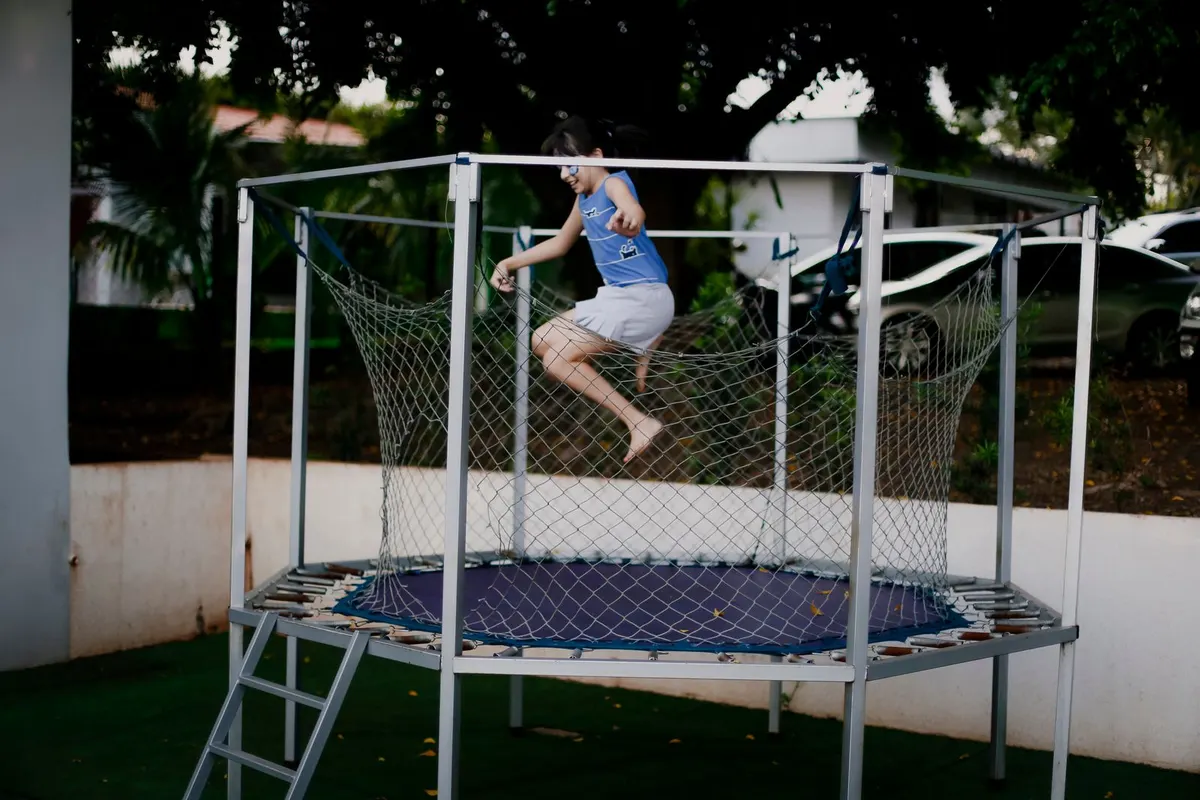
To measure a trampoline, run a tape across the frame from one outside edge to the opposite outside edge, count the springs, and measure one spring from hook end to hook end with it removed. (How to Measure a Trampoline) Those three numbers, plus the shape, are what a parts store needs to sell you the right mat, springs, pad or net. Measure everything at least twice before you order. (How to Measure a Trampoline for Replacement Parts)
We earn a commission if you buy through the store links below, at no extra cost to you. (FTC's Endorsement Guides: What People Are Asking)
Most people go looking for this in spring, when the cover comes off and the winter damage shows. U.S. searches for “how to measure a trampoline” jump from 390 in January to 1,900 in March and April, and “trampoline mat replacement” holds at 5,400 a month from March to June, according to Google Keyword Planner. (Google search volume data for terms) Measuring now, before the rush, gives you time to order.
What you need
Our advice: a tape measure long enough to span the frame (16 feet covers most backyard models), a notepad, work gloves, and a helper to hold the far end. Pliers or a spring-pulling tool help when you take a spring off to measure it.
Step 1: Measure the frame
This is the size the trampoline is sold as, and the size most replacement mats, pads and nets are listed under.
- Round: hook the tape on the outer edge of the metal frame and pull it straight across, through the center, to the outer edge on the other side. SkyBound suggests doing it twice like a clock face: 12 to 6, then 3 to 9. (Trampoline Measurement Guide: Mat, Springs, Nets & More) If the two numbers differ, the frame is bent and worth checking before you buy parts.
- Rectangle: measure the frame’s length, then its width.
- Octagon: measure corner to corner, then again at a right angle, and average the two.
The most common mistake is measuring from the row of spring holes instead of the outside edge of the frame. That shaves inches off the number and gets you a part one size too small. Springfree also recommends taking the frame measurement with the springs and mat still installed, so the frame holds its true shape.
Find parts for your size at Trampoline Parts and Supply
Step 2: Count the springs
Count the holes in the top rail of the frame where the springs attach, or count the V-rings sewn around the edge of the mat. The two numbers should match: one spring per V-ring. On a round trampoline you need the total. On a rectangle, write down the count along the length and along the width separately; on an octagon, the count per side.
A replacement mat has to have the same number of V-rings as your frame has holes, or it won’t hang evenly. This is the number people skip, and it matters as much as the diameter.
Step 3: Measure a spring
Take a spring off. Measure it from the end of one hook to the end of the opposite hook, not just the coiled part. SkyBound recommends pulling three springs and comparing them, because springs stretch over time and one tired spring can give you the wrong length. Measure them relaxed, never stretched or bent.
Are your springs worn out? SkyBound’s quick check: if you can slide a sheet of printer paper between the coils of a spring at rest, it’s overstretched and should be replaced. Springfree puts the typical life of springs at two to four years. Our advice: replace them as a full set so the mat pulls evenly.
Shop springs and parts by size at Trampoline Parts and Supply
Step 4: Measure the mat itself (if it’s still there)
If the old mat is intact enough to measure, run the tape across the fabric only, edge to edge, without the V-rings. On a rectangle, take the length and the width of the bed, again without the V-rings. On an octagon, measure the width along the weave of the fabric, not on the diagonal.
Don’t be surprised that the mat is much smaller than the frame. Springfree’s example: a 10-foot spring trampoline has a mat that actually measures about 8 feet, because the springs take up the rest. That’s why stores list mats by frame size and spring count. The fabric number is a cross-check, not the order size, and old mats stretch, so trust the frame and the spring count first.
See replacement mats at Trampoline Parts and Supply
Step 5: Size the safety pad
The spring pad follows the frame: a 10-foot round trampoline takes a 10-foot pad. For a rectangle, write down the frame’s width and length, plus the distance from the outside of the frame to the edge of the jumping bed, which tells you how wide the pad has to be to cover the springs. If your enclosure poles pass through the pad, count them too, so the cut-outs line up.
See vinyl spring pads at Trampoline Parts and Supply
Step 6: Size the enclosure net
Nets are sold by frame size and by how many poles hold them. Count the enclosure pole connection points around the frame: Springfree’s example is a 12-foot trampoline with six. Our advice: also note whether the net hangs inside the springs (attached to the mat) or outside the pad (attached to the frame), and check the old net’s height.
See enclosure nets by size at Trampoline Parts and Supply
Your measuring checklist
| What to write down | Round | Rectangle | Octagon |
|---|---|---|---|
| Frame size | Outside edge to outside edge, twice | Length and width | Corner to corner, twice, averaged |
| Springs | Total count | Count along length and along width | Count per side |
| Spring length | Hook end to hook end, removed | Same | Same |
| Mat fabric (cross-check) | Diameter without V-rings | Length and width without V-rings | Width along the weave |
| Pad and net | Frame size, pole count | Frame size, frame-to-bed distance, pole count | Frame size, pole count |
Our advice: bring the brand and model too, if the label on the frame leg is still readable. It’s the fastest way to confirm a match.
When to replace parts instead of the trampoline
Our advice: a torn mat, a few overstretched springs or a cracked pad are routine repairs on a sound frame. A rusted-through or bent frame is not. The American Academy of Orthopaedic Surgeons says to discard worn or damaged equipment if replacement parts aren’t available, and to keep padding on the frame and springs in good condition. (Avoid trampoline injuries)
The same group reported 313,850 trampoline-related injuries treated in 2018, citing Consumer Product Safety Commission data, and its advice for home trampolines is simple: one jumper at a time, no children under 6, and an adult watching. A net helps, but most injuries happen on the jumping surface, so don’t rely on it alone.
Related guides
Shopping for a new one instead? See our picks for the best trampolines for Christmas. For the rest of the backyard crowd, see our gifts for gardeners and gifts for campers.
Bottom line
Measure the frame from outside edge to outside edge, count the springs, and measure one spring hook to hook. Write all three down with the shape, and you can order a mat, springs, pad or net that fits the first time.
Shop trampoline parts by size at Trampoline Parts and Supply
Sources & method
Who this guide is for
This guide is for trampoline owners in the U.S. replacing a torn mat, stretched springs, a faded pad or a ripped net who need the right size the first time.
How we researched this
- This is a research-based guide, not a hands-on product test.
- Every measurement and safety figure is attributed to the source it comes from. Where we give our own advice, we say so.
- We don’t rank or recommend specific products in this guide.
Sources
- Springfree Trampoline — How to Measure a Trampoline for Replacement Parts (accessed Nov 15, 2026). Frame measured from one outside edge to the other with springs and mat installed; measure at least twice; a 10-ft spring trampoline's mat actually measures about 8 ft; springs measured hook end to hook end, not stretched; nets sized by counting enclosure pole connection points; pads match the frame size; springs every 2-4 years, pads and nets yearly on cheaper models.
- SkyBound USA — Trampoline Measurement Guide: Mat, Springs, Nets & More (accessed Nov 15, 2026). Outer edge to opposite outer edge, 12-to-6 and 3-to-9 o'clock; common mistake is measuring from the spring holes; v-ring count should match the number of springs; measure three springs hook end to hook end; printer-paper test for overstretched springs; octagons measured corner to corner twice and averaged.
- Trampolines.com — How to Measure a Trampoline (accessed Nov 15, 2026). Round: frame outside to outside is the typical stated size; bed diameter without v-rings; count the frame holes; spring measured end of hook to end of hook with the spring removed. Rectangle: bed length and width without v-rings plus spring count per side. Octagon: width with the weave, not on the bias. Rectangle pads: frame width, length and frame-to-bed distance.
- American Academy of Orthopaedic Surgeons — Avoid trampoline injuries (accessed Nov 15, 2026). 313,850 trampoline-related injuries treated in 2018 (CPSC data); one jumper at a time; no children under 6; padding in good condition; don't rely only on nets; discard worn or damaged equipment if replacement parts are unavailable.
- Federal Trade Commission — FTC's Endorsement Guides: What People Are Asking (accessed Nov 15, 2026). Why we disclose affiliate links next to them.
- Google Keyword Planner — Google search volume data for terms: “how to measure a trampoline”, “trampoline mat replacement”, “trampoline springs”, “trampoline net replacement”, “trampoline parts”, “trampoline replacement parts”, “trampoline safety”, “how to anchor a trampoline” (U.S., accessed Nov 15, 2026).
Review history
- Published Nov 15, 2026.