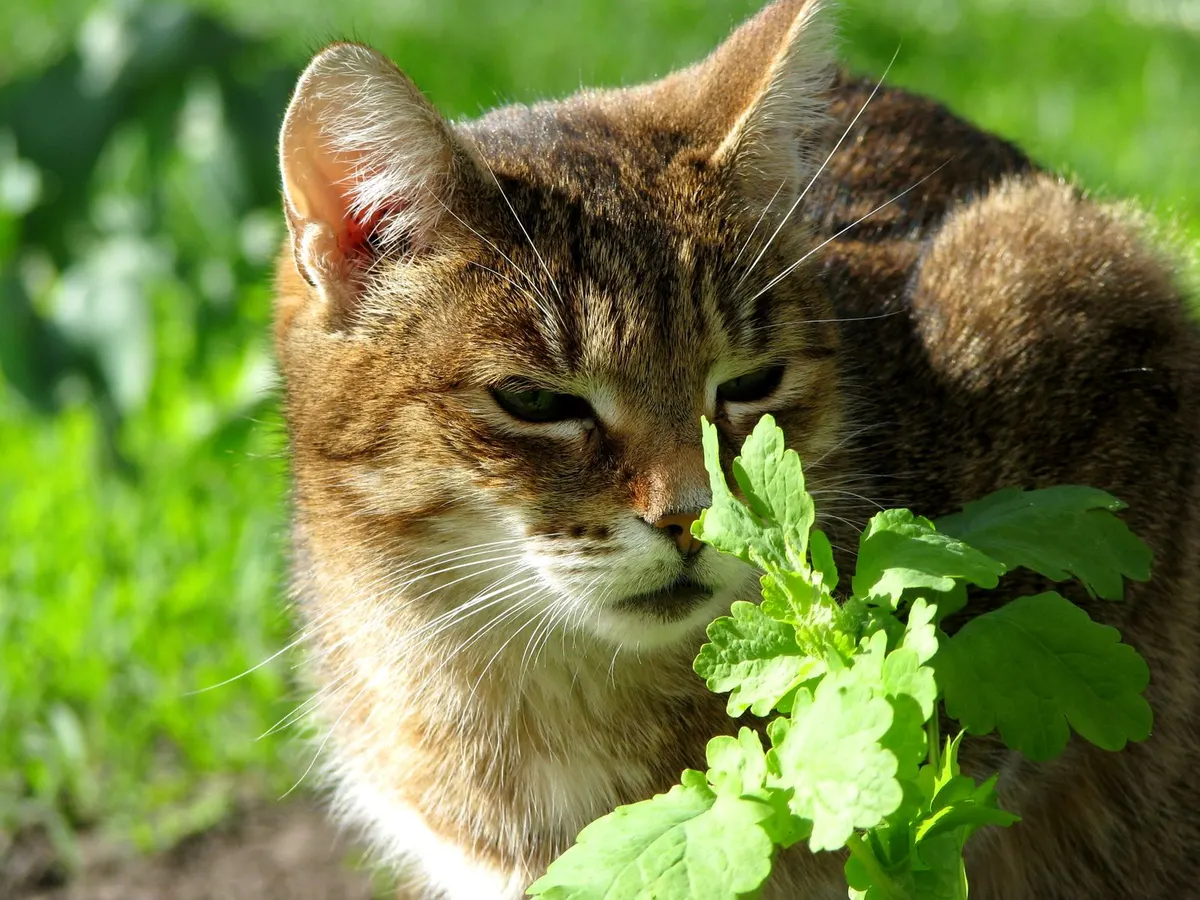
Silvervine is the best bet for a cat that ignores catnip. In a 2017 study of 100 cats, 79% reacted to silvervine and 68% to catnip (a gap too small to rule out chance), the reaction to silvervine was stronger, and almost three out of four cats that ignored catnip still reacted to silvervine. (Responsiveness of cats (Felidae) to silver vine (Actinidia polygama), Tatarian honeysuckle (Lonicera tatarica), valerian (Valeriana officinalis) and catnip (Nepeta cataria)) If your cat shrugs at catnip, silvervine is the next thing to try. If catnip already works, there’s no need to switch. It’s a common question: in the U.S., about 9,900 searches a month ask why cats like catnip, and 4,400 look for silvervine sticks for cats.12
Silvervine vs catnip at a glance
| Silvervine | Catnip | |
|---|---|---|
| Plant | Actinidia polygama, a climbing vine from East Asia, called matatabi in Japan | Nepeta cataria, an herb in the mint family |
| Main active compound | Nepetalactol (The characteristic response of domestic cats to plant iridoids allows them to gain chemical defense against mosquitoes) | Nepetalactone (Toxic and Non-toxic Plants: Catnip) |
| Cats that reacted (2017 study) | 79% | 68% |
| Strength of reaction | Rated more intense | Milder on average |
| Common forms | Powder from fruit galls, sticks | Dried leaves, spray, stuffed toys |
What is silvervine?
Silvervine (also written silver vine) is a climbing plant from East Asia, known as matatabi. It’s commonly used to excite cats in Japan, and a 1906 letter in the journal Science already described American cats going for it after it was brought over from China, according to the 2017 study.
The part cats like most is the fruit gall: a lumpy fruit that forms when a tiny fly, the gall midge, lays its eggs inside. Dried and ground, galls become silvervine powder. In the study, cats responded mainly to the galls, and only some responded to the wood. Researchers later found that nepetalactol, a compound in silvervine, is the main reason cats rub their faces on it and roll around.
Why do cats like catnip?
Catnip contains nepetalactone, an oil cats pick up through the nose. (What Is Catnip?) The effect comes from the smell, not the taste. A cat that responds usually sniffs, licks and bites the leaves, rubs its chin and cheeks on them, rolls over and sometimes kicks with its back legs. The study’s authors note this reaction isn’t sexual. Silvervine sets off the same set of behaviors.
Humane World for Animals (formerly the Humane Society of the United States) says sniffing catnip tends to make cats playful, while eating it tends to make them calm, and that a session usually lasts around 10 minutes. After that, the cat stops responding for about two hours.
Do all cats like catnip?
No. One in three cats in the 2017 study didn’t respond to catnip, and Humane World for Animals puts the share of non-responders at 30% to 50%. It says the trait is inherited, and that kittens usually don’t react until they’re 3 to 6 months old.
This is where silvervine earns its place. Of the cats that ignored catnip in the study, almost 75% responded to silvervine. About half the cats also reacted to Tatarian honeysuckle and valerian root, two less common options.
Is silvervine safe for cats?
The 2017 study’s authors describe silvervine, catnip, valerian and Tatarian honeysuckle as generally considered safe and not addictive for cats, and say the Pet Poison Helpline had no reports of toxicity from silvervine. No large safety study exists, though.
Sticks need one more check. Cornell’s Feline Health Center warns against toys with small pieces or string-like parts a cat could swallow. (Safe toys and gifts) Silvervine sticks are often wrapped in rope or raffia, so supervise chewing and throw a stick away once the wrapping comes loose.
Is catnip safe for cats?
Mostly, with one caution. The ASPCA lists catnip as toxic to cats and says it can cause vomiting and diarrhea; it also makes some cats drowsy and others wound up. Humane World for Animals says that’s usually a problem only when a cat eats a lot of it. Our advice: offer small amounts, put it away after the session, and stop if your cat vomits or has diarrhea. Call your vet if it doesn’t settle.
Silvervine sticks for cats
Silvervine sticks (also sold as matatabi sticks) are cut from the plant’s wood, and the study’s results for wood were weaker than for the fruit galls: in a smaller follow-up test, only one of eight cats responded to woodchips from silvervine sticks, and even that cat spent less time with the wood than with the galls.
That doesn’t make sticks useless. They’re tidier than powder and easy to toss to a cat. But if a stick gets no reaction, try silvervine powder before deciding your cat doesn’t respond to silvervine at all.
Silvervine powder for cats
Powder made from dried fruit galls was the form cats liked best in the study. A pinch goes on the floor, a toy or inside a sock. It’s messier than a stick, but it’s the closest match to what the study tested.
Catnip and silvervine: how to test both at home
Our advice, based on how the study offered the plants:
- Start with catnip if you’ve never tried it. Rub a pinch of dried catnip between your fingers or put it in a sock, and offer it for 10 minutes.
- Wait a few days, then try silvervine the same way. Offering one at a time is the only way to know which one your cat reacts to.
- Watch for the classic signs: sniffing, licking, cheek rubbing and rolling. A quick sniff and walk-away counts as no reaction.
- Retry later with a young kitten or a cat that seemed unsure. Some cats need a second or third try.
Kitty Kick Stix, a small U.S. shop that has made catnip toys since 2012, sells both sides of the test. (Kitty Kick Stix home page) Its silvervine sticks combine silvervine wood with a fruit gall and come in a set of 4 for $12.49 (the 2-pack at $7.29 was sold out on Nov. 18, 2026). (Silvervine Sticks (Multi Pack)) For catnip, its Premium Catnip Spray ($8.79 for 1.45 fl oz) can wake up old toys, (Premium Catnip Spray) and the Classic 15-inch Kicker 2-pack ($17.49) is a stuffed toy packed with organic catnip for cats that like to bunny-kick. (Classic 15" Kicker Set (2 Pack)) Prices as checked on Nov. 18, 2026.
See the silvervine sticks at Kitty Kick Stix
See the catnip spray at Kitty Kick Stix
Shipping and returns at Kitty Kick Stix
Shipping is free on orders over $39. The store says orders ship within 24 to 48 hours, though its handmade toys can be delayed at busy times. (Shipping policy) It doesn’t take returns unless a toy has a manufacturing defect, and it says plainly that it can’t guarantee every cat will enjoy catnip. (Refund policy) Our advice: since you can’t send a toy back because your cat ignored it, start with the cheapest option of each plant. We found no coupon for this store on Nov. 18.
More for cat owners. For toys built around catnip, see our best cat toys. Shopping for the person instead? Try our gifts for cat lovers. Decorating for the holidays? Read are poinsettias toxic to cats first.
Silvervine vs Catnip: FAQ
Is silvervine stronger than catnip?
In the 2017 study of 100 cats, more cats reacted to silvervine than to catnip (79% vs. 68%, a gap too small to rule out chance), and the reaction to silvervine was rated more intense. That doesn't mean every cat prefers it: some cats react only to catnip.
Can kittens have catnip or silvervine?
Kittens usually don't react to catnip until they're about 3 to 6 months old, according to Humane World for Animals. We found no good data on silvervine and young kittens. If a young kitten ignores either one, try again when it's older.
How long does the reaction last?
Humane World for Animals says a typical catnip session lasts about 10 minutes, and then the cat stops responding for about two hours. Short sessions with a break in between work better than leaving it out all day.
Is catnip good for cats?
For most cats it means a short burst of play from the smell, and Humane World for Animals calls it generally safe. Still, the ASPCA lists catnip as toxic to cats because eating it can cause vomiting and diarrhea, so offer small amounts and put it away afterward.
Can I give my cat silvervine and catnip at the same time?
There's no study on mixing them. Our advice: offer one at a time, a few days apart, so you can tell which one your cat actually reacts to.
Answers based on: Bol S. et al. (2017), BMC Veterinary Research; Humane World for Animals (formerly the Humane Society of the United States); ASPCA. We don’t invent questions.
Sources & method
Who this guide is for
This guide is for cat owners whose cat ignores catnip, or who keep seeing silvervine sticks and want to know if it's worth trying.
How we researched this
- This is a research-based guide, not a hands-on product test.
- Every measurement and safety figure is attributed to the source it comes from. Where we give our own advice, we say so.
- We don’t rank or recommend specific products in this guide.
- Researched and drafted with the help of AI tools, then checked against the cited sources by the SHOP & SPOT editors.
Sources
- Bol S. et al. (2017), BMC Veterinary Research. “Responsiveness of cats (Felidae) to silver vine (Actinidia polygama), Tatarian honeysuckle (Lonicera tatarica), valerian (Valeriana officinalis) and catnip (Nepeta cataria).” Accessed . 100 domestic cats tested: 68% responded to catnip, 79% to silver vine; almost 75% of catnip non-responders responded to silver vine; fruit galls worked better than wood.
- Uenoyama R. et al. (2021), Science Advances. “The characteristic response of domestic cats to plant iridoids allows them to gain chemical defense against mosquitoes.” Accessed . Nepetalactol is the main compound in silver vine behind the rubbing and rolling response.
- ASPCA. “Toxic and Non-toxic Plants: Catnip.” Accessed . Lists catnip as toxic to cats; it can cause vomiting and diarrhea, and makes some cats sedated and others stimulated.
- Humane World for Animals (formerly the Humane Society of the United States). “What Is Catnip?” Accessed . About 30% to 50% of cats don't react; kittens usually start between 3 and 6 months; sessions last about 10 minutes, then about two hours of no response.
- Cornell Feline Health Center. “Safe toys and gifts.” Accessed . Avoid toys with small pieces and string-like parts a cat could swallow.
- Kitty Kick Stix. “Silvervine Sticks (Multi Pack).” Accessed . Sticks made of silvervine wood, raffia, sisal rope and silvervine fruit gall, about 8.7 inches long; set of 4 $12.49; set of 2 ($7.29) sold out on Nov. 18.
- Kitty Kick Stix. “Premium Catnip Spray.” Accessed . 1.45 fl oz of steam-distilled catnip oil to spray on toys and scratchers; $8.79, regular $9.95.
- Kitty Kick Stix. “Classic 15" Kicker Set (2 Pack).” Accessed . Cotton kicker toys packed with organic catnip; $17.49, regular $21.95.
- Kitty Kick Stix. “Kitty Kick Stix home page.” Accessed . Free shipping on orders over $39; catnip kickers since 2012.
- Kitty Kick Stix. “Refund policy.” Accessed . No returns except manufacturing defects (replacement); the store says it can't guarantee every cat enjoys catnip; shipping is non-refundable.
- Kitty Kick Stix. “Shipping policy.” Accessed . Orders ship within 24 to 48 hours; handmade, so production delays can happen.
- Google search data. “U.S. monthly search volume: ‘silvervine vs catnip’, ‘silvervine for cats’, ‘why do cats like catnip’, ‘is catnip safe for cats’, ‘silvervine sticks for cats’, ‘matatabi’, ‘what is silvervine’, ‘is silvervine safe for cats’.” Accessed .
Review history
- Published .